aaron-bell-wakeboard.png
Aaron Bell

Owner, Deja Vu Ski & Board · 20+ years wakeboarding · Former State & National wakeboard champion

First up, let’s make something clear: there is a “right” wakeboard for you.

But when every brand tries to convince us that every board rides fast, has explosive pop, and offers pillow-soft landings, it’s hard to figure out what genuinely works for you, and what doesn’t.

The reality: not every wakeboard is the same. Some ride slow. Some have more mellow pop. And some don’t soften landings as much. That’s ok — because different attributes suit different riders, and sometimes you need to give something up to make something else better.

Don’t let all that scare you away though. Choosing the right board is actually fairly easy once you know what to look for.


Three golden rules

These are the shortcuts that stop most buying mistakes.

1. Be ok with being boring

Wakeboard design and technology moves fast. And it’s always tempting to spend a little extra on some fancy new tech that's just hit the market.

Ultimately, most people that chase "the best" end up spending the most — then hit the water and realise they can't handle it.

Often the best board for you feels like the boring choice.

But a wakeboard that suits you will always make riding more fun than one that just sounds impressive. So don’t get pulled into the latest tech or niche features if they’re unlikely to suit you.

2. Buy for now

It’s really tempting to find a board that’s going to suit you forever — one that you can grow into. That’s especially the case when buying for kids or teens. And that makes sense.

But if it comes at the expense of your riding today, then it’s the wrong call.

Buying a board that suits your riding now will help you progress faster. Try to jump ahead and you’re more likely to see your riding plateau, maybe even go backwards, while you fight a board that’s doing things you can’t seem to control.

3. Don’t ignore bindings

This isn’t a call to spend more — it's simply a warning to manage expectations if you're not ready for new boots as well.

Because it's hard to get the most out of your new board if you stick 10-year-old bindings on it.

Over time, wakeboard bindings wear down — just like shoes. The stiffness and support you had when they were new disappears. By putting your old, worn out bindings on your nice new board, you’ll mute some of the energy you put in, limiting how much it can help your riding progress.

Wakeboard design features you need to know

There’s a lot of terminology that gets thrown around these days — but only a few truly make a difference to how a board rides. So as you check out the latest catalogues, keep an eye on these.

Base design

This is often overlooked, but is usually the best indicator as to how a board will feel on the water. Most boards sit between two extremes.

On one end you have a completely flat base. These boards sit higher on the water as you ride and, with nothing to control the flow of water, they glide faster and release easier — giving you a fast and loose feeling.

At the other end of the spectrum are boards with deep channels and rails throughout the base. This will draw the board deeper into the water, offering a slower, more “locked in” feel. This often suits riders looking for confidence and edge control.

In reality, few boards sit at the extreme end of the spectrum — most prioritise one feel over another without giving absolutely everything away.

Rocker

If you lay a wakeboard on the floor you’ll notice the tip and tail bend up away the ground. This bend is called “rocker”.

Broadly speaking, there are two rocker profiles: continuous and 3-stage. Continuous is a smooth, consistent bend through the board. It offers a faster and more predictable ride — both through the water and in pop off the top of the wake.

Conversely, 3-stage is shaped with a flatter section through the middle with a more abrupt bend beneath the bindings. This gives a more aggressive feel in how it transitions from edge-to-edge, and also off the wake — but at the expense of consistency and speed.

Today, the choice between continuous or 3-stage rocker isn’t binary like it used to be. Many boards have a blend of both but, like base design, they tend to lean towards one end of the spectrum or the other.

Construction

For boat riding, a stiff board is usually preferred — especially for more advanced riding. These release energy quickly as you transition between edges, and when you pop off the wake, meaning quicker reaction times and more air time when you get things right. But the materials used (e.g. carbon) are usually more expensive than a traditional core.

Park boards are different — here flex and durability are king. When you ride at a cable park, you’re most likely going to want to hit all the features (kickers, rails etc.). These put serious stress through your board, so these boards are built with flex, more durable sidewalls and a specific base that will stand up to being dragged over all kinds of non-water materials. As a bonus, that flex is way more fun on features.

If you’re planning on splitting time between both boat and park, there are hybrid boards available. These tend to be skewed more towards park construction than boat, meaning you’re sacrificing your boat riding more.

Our tip (if buying multiple boards is off the table): buy for where you ride most and borrow or hire for the other.

Fin setup

Most modern wakeboards will feature either a quad fin (one on each side at each end) or 6-fin (quad plus a centre fin at each end) setup.

The centre fin is primarily a tool for beginners. It helps drag the board into tracking straight, rather than allowing it to drift around — super important for a new rider trying to establish body position and handle control.

Centre fins are generally removable. Once you’re comfortable with basic edge control and crossing over both sides of the wake, have a go without it — your board will instantly feel more responsive and free.

Side fins focus on edging power. The bigger (depth or length) these are, the more you can lean on your edge without the board sliding out from under you. Fins closer to the edge of the board — side and tip/tail — offer more responsiveness.

Fin placement will often complement base design — for example a flatter base may feature larger fins to help compensate a faster, looser ride with sufficient edge control.

How to choose

Every board on the market offers a slightly different mix of each feature-set.

The best place for you to start is by simplifying what you want then matching that to the most suitable features.

For example, a rider that's comfortable with deep-water starts and beginning to look at wake jumps/grabs will most likely want a cleaner, more forgiving base, a hybrid rocker, and won't require a centre fin.

At the bottom of this guide, we've outlined the most common buying scenarios we see what what to look for.


Size matters — but not in the way you think

It’s surprising how often someone looking for a new wakeboard starts with “what size should I get?”. Really, size is one of the last considerations.

Most models across most brands will come in a range of sizes — only once you’ve worked out what board will suit should you think about picking the right size.

Below we’ve dropped in a quick reference sizing chart which is predominately based on rider weight ranges. You can skip ahead to that if you prefer. But it may be worth digging a little deeper to better understand why we recommend those sizes — and when to consider going beyond what the chart suggests.

And if you're after even more information on sizing, you can view our wakeboard size guide here.

Board shape

Wakeboard size ultimately comes down to surface area — you want enough board beneath your feet to keep you on top of the water, without having so much that the board becomes unresponsive to your inputs. The shape of the board has a huge role to play here.

A wider board will give more surface area at smaller sizes. This means you may be able to look to the lower end of the size range for your weight, or potentially drop back a level completely, to get more responsiveness from your board.

Riding style

This is a personal preference. Some riders prefer to go up a size in boards relative to the “typical” size recommendation. Most often these riders are chasing a more stable, forgiving ride and are happy to sacrifice some responsiveness to do so.

This also provides the benefit of being able to drop boat speed down a little — giving you more punch off the wake (depending on your boat) and softer landings.

Boat vs Park riding

You’ll notice the chart below recommends two size ranges for each weight range; one for boat and one for park. This mostly boils down to riding speed. A cable park generally operates around 5-8kph slower than you’d ride behind a boat, necessitating more board to keep you on top of the water comfortable. A bigger board also provides more stability and flex when hitting features.

Quick reference - Wakeboard size chart

Rider weight (kg) 20-35kg 30-45kg 40-65kg 60-80kg 75-95kg 90-115kg 115kg+
Board size (boat) 115-125cm 125-130cm 128-135cm 133-139cm 137-142cm 140-145cm 144cm+
Board size (cable) 125-130cm 130-136cm 133-139cm 137-144cm 142-148cm 146-152cm 150cm+

A quick note on wakeboard bindings

As the piece of kit that connects you to your wakeboard, it’s vital to get the right bindings. Let’s untangle some of the features you’ll see and what they do.

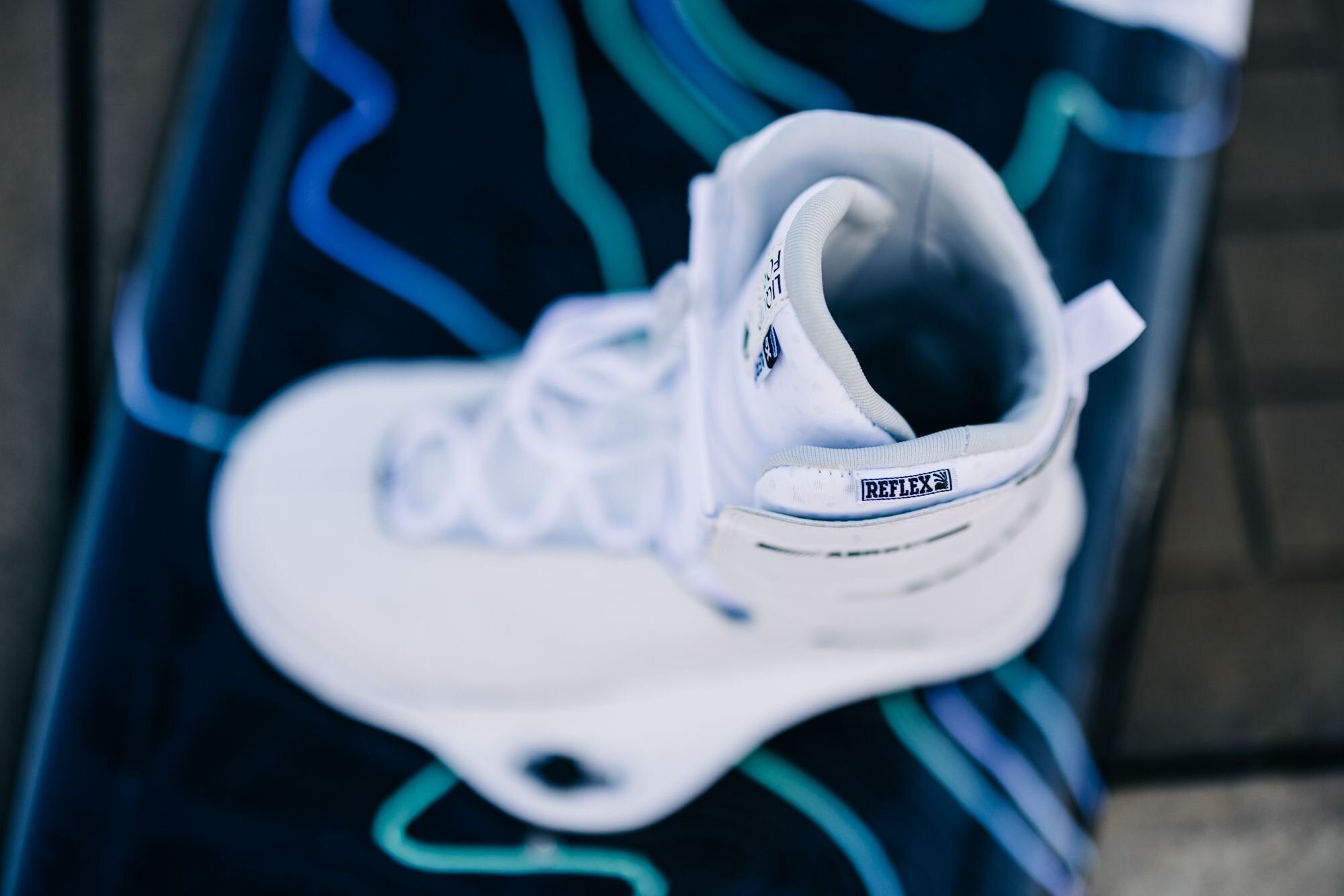
Construction: open-toe bindings offer great value and versatility while closed-toe provides superior support, performance and comfort. For shared setups, first timers, and those with tighter budgets open-toe is recommended. However, if budget permits, and you’re more focused on progression, closed-toe is the better option for you.

Fastening system: most bindings come with either velcro straps or laces. Velcro is your value option, but also enables the binding to open up more for easier entry/exit. Lace systems are generally the better option — they’re easier to fully tighten, generally last longer, and are easier to replace if they do happen to break.

For Park riders, you might want to consider step-in style bindings. Options like Hyperlite Systems (snowboard style) or Slingshot and DUP’s removable inner liners enable riders to quickly remove their board and walk back to the dock after each fall. For boat, these can work, but a traditional binding will work better.


How much does a wakeboard cost?

It can be disheartening when you’re sold the dream of a new wakeboard only to find out it’s hundreds of dollars above your budget. So it’s important to understand what you can get for your money.

Board only

As an entry point you'll be looking at between $500-$600 across most brands. At the $700-$900 range you'll be looking at more refined suited towards intermediate-advanced level riders. Over $1,000 you're looking at a serious piece of kit. Carbon layers, ultra light cores will offer supreme levels of performance if you have the budget.

Of course, unless you already have some old bindings, you'll need to consider those in your budget too.

Bindings

At the entry level we're seeing prices under $300 for some open toe bindings, however most brands operate int he $300-$400 range for this level.

Higher performing, closed toe bindings typically start around $600 and can shoot up to over $1,000.

Differences between brands

Higher prices are generally commanded by global brands like Liquid Force, Hyperlite and Ronix. These brands are constantly pushing design and technology barriers and, as great as it is to have new and better gear available each season, that R&D doesn’t come cheap.

However, brands like Raptor, Jobe and Connelly are serving up some incredible product that will serve most wakeboarders on Aussie lakes and rivers perfectly fine — and they’re usually doing it at a lower price point.

The chain store conundrum

Drop in to your local big name chain store and you’re likely to see packages around the $600 mark, maybe even lower. This stuff is cheap, usually at the expense of design, durability and quality.

If you’re just dipping your toes in the water (no pun intended) with wakeboarding, or want something to throw around a little more, these are a fair option.

But for someone riding throughout summer and looking to progress their skills, you’ll ultimately be happier on a lighter, more durable, and more refined setup that specialist brands and stores offer.

Common wakeboard buying scenarios — and what to look for

Here, we’ve outlined the buying situations most of our customers fall into. As unique as you might be, there’s an above-average chance you’ll fall into one of these groups.

That doesn’t mean you need the same board as everyone else — but you will want one with similar DNA.

FINAL SAY

Don't overcomplicate it

Too many people overthink the new wakeboard decision. They start with size, get pulled into brand comparisons, then talk themselves into spending more than they need to on a board they can't keep up with.

The riders who get it right tend to do the opposite — they start with the basic characteristics they want, then look for the features that suit and pick the board that does that job at a price that makes sense.

It seems like the more boring approach, but it's the right one — and ultimately leads to having a lot more fun once you hit the water.

We're here for the ride

Choosing a wakeboard isn't a spur-of-the-moment decision without consequences. Getting it wrong can dampen your enthusiasm, send your riding backwards, or worse — get you hurt.

That's why we exist. Not to sell, but to help.

We'd much prefer to see you riding all summer with a grin from ear to ear than upsell you to a more expensive board you can't ride.

If you've gone through this whole page and still aren't quite sure where to start, hit the button below. There's only 20+ years of wakeboarding experience waiting for you on the other side.